Self-care is crucial for life and living: meeting the basics for well-being.
Self-care is essential to living and spans so many aspects of our lives. Most of us know that part of self-care is paying attention to our diet and physical fitness/health, and some of us might know about good sleep hygiene, but what about self-care in respect to our personal relationships, work life and general preserving of our internal “battery”?

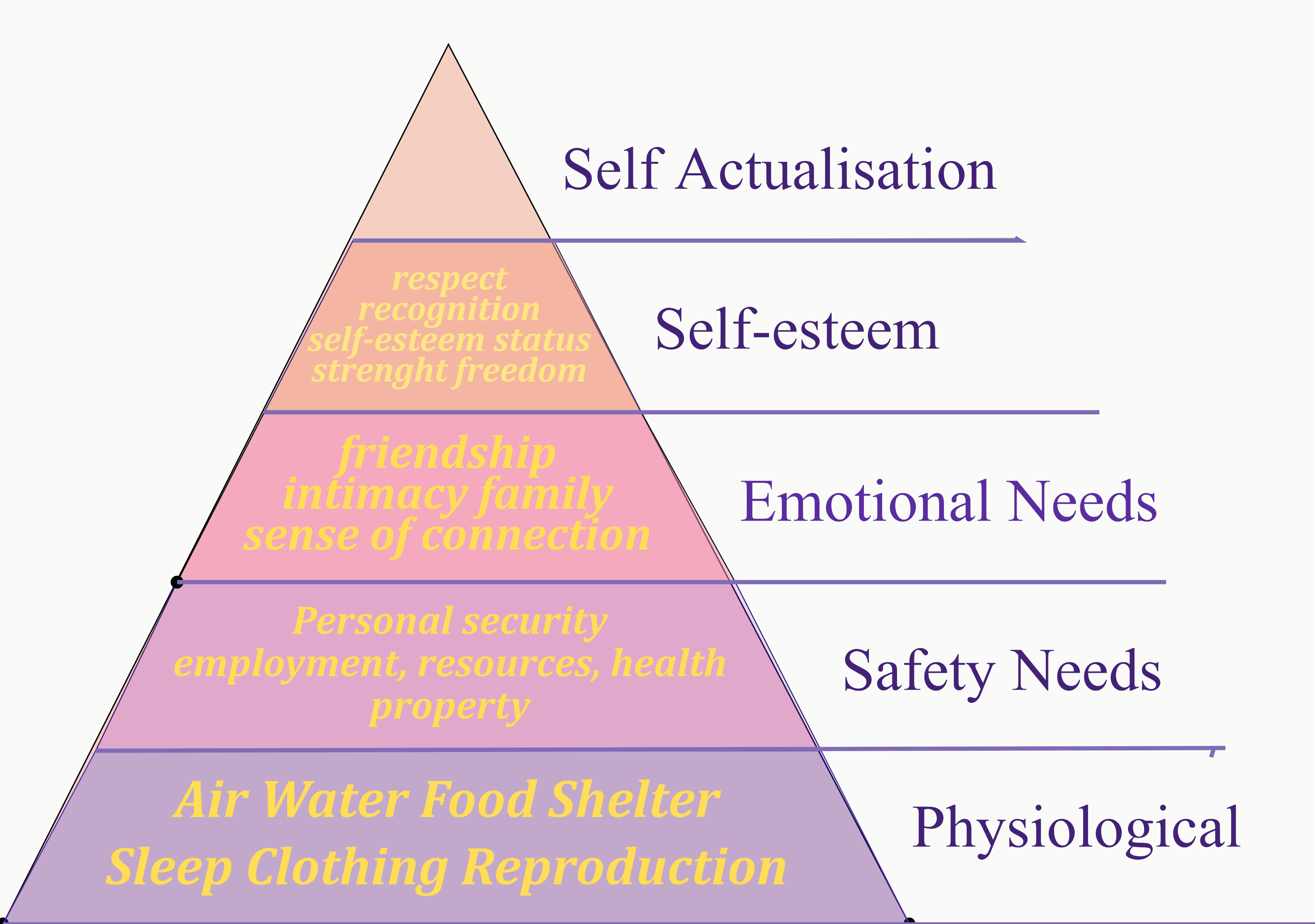
There are many ideas around how we can achieve wellbeing, but how do we navigate this, where can we start? There is so much information out there and it can be difficult to figure out what we might need to prioritise. A good way we might approach wellbeing is by looking to Maslow’s Heirarchy/Pyramid (below). Maslow is a prominent early psychologist who considered that in order to function at our most optimum, we required a specific set of things in life in an order of priority. Without food, water and shelter, as human beings we would not be satisfying our basic survival needs, which would absolutely affect our ability to function. Without feeling safe and secure, we would find it difficult to flourish.
As social beings we crave friendships and relationships with others, and having a sense of belonging with a social group is thought of as a deep need for people. Without these connections, we can feel on the outside and find life’s challenges that little bit harder.

Maslow’s Pyramid (above) helps to illustrate a way we can approach our well-being by representing it with “layers” that make up our overall experience of wellbeing. By taking care of our physical and safety/security needs and maintaining social connections, we can give ourselves a good foundation for optimal functioning. Initially, Maslow intended this to illustrate his concept of ‘self-actualisation’, which meant to function at our absolute best and thought only few people would reach this. However, many have adopted it to provide a guide for achieving wellbeing, replacing the idea of self-actualisation, and it has shown to be a good illustration.

This idea says we need to take care of our physiological needs, safety needs, belonging needs, self esteem, and then we get to our best. Without first meeting the layers at the bottom of the pyramid, we cannot properly create a foundation for the layers above.
This makes sense, as without properly sleeping, eating, rehydrating we would not get far; also, the need to make sure we are safe, if we were in a constant state of fear of attack or other danger, how could we think about building self-esteem? If our goal is feeling well and satisfied, we need to ensure we cover the basics first.

For purposes of illustration we refer to this idea throughout these resources, and will use it as a guide in unfolding a large picture.